
Wellness & Longevity
What Types of Peptide Bioregulators Exist?
40
Useful Links
References
Peptide bioregulators
Peptide Bioregulators
— Short chains of amino acids extracted from animal organs and tissues or synthesized, belonging to the class of biologically active substances in pharmacology. They work by interacting with cellular receptors, enzymes, and other molecules to regulate various physiological processes. Bioregulators can help to optimize cellular metabolism, repair damaged tissues, enhance organ function, and support overall health and well-being.
Go to Glossary
are a group of short
peptides
Peptides
— A family of substances whose molecules are built from two or more amino acids. Peptides encompass around half of all known hormones and the majority of enzymes.
Go to Glossary
and peptide complexes that appear to influence gene expression, protein synthesis, and cellular stress responses, with the aim of restoring or maintaining tissue homeostasis. Note that most data come from experimental models and small human studies, which suggest organ‑specific and age‑related effects, but large, high‑quality clinical trials are still lacking. In this article, we will explore the different types of peptide bioregulators, their key differences, and the current state of research.
Origins of Peptide Bioregulators
Peptide bioregulators as a therapeutic concept were developed by Professor Vladimir Khavinson (that's why they are referred to as Khavinson Peptides) and colleagues, initially in the Research Laboratory of Bioregulators of the S. M. Kirov Military Medical Academy and later at the St. Petersburg Institute of Bioregulation and Gerontology. Over several decades this group isolated organ‑specific peptide complexes from animal tissues and also created synthetic short peptides with defined sequences based on these natural regulators. You can read more here.
Many peptide bioregulator formulations, including individual short peptides and organ‑specific complexes, are protected by Russian and international patents held by Khavinson and collaborating organizations (the Institute of Bioregulation and Gerontology, PeptideBio, and others). According to the Institute, more than 100 patents cover different peptide substances, compositions, and methods of obtaining tissue‑specific peptides, and several of these preparations have been registered as medicinal products in Russia.
Types of Peptide Bioregulators by Origin
Natural Animal-Derived Peptide Bioregulators
Natural peptide bioregulators are extracted from animal organs and tissues. They closely resemble the body’s own regulatory molecules, allowing tissue-specific effects such as stimulating protein synthesis in the same organs from which they are derived. They may have a delayed but potentially longer‑lasting effect.
Synthetic Peptide Bioregulators
Synthetic peptides are lab-designed molecules modeled after natural peptides. They are shorter fragments, often derived from plant amino acids, and engineered to replicate natural activity. They act faster (effects in 2–3 days) but are shorter in duration.
Comparison of Peptide Bioregulator Products
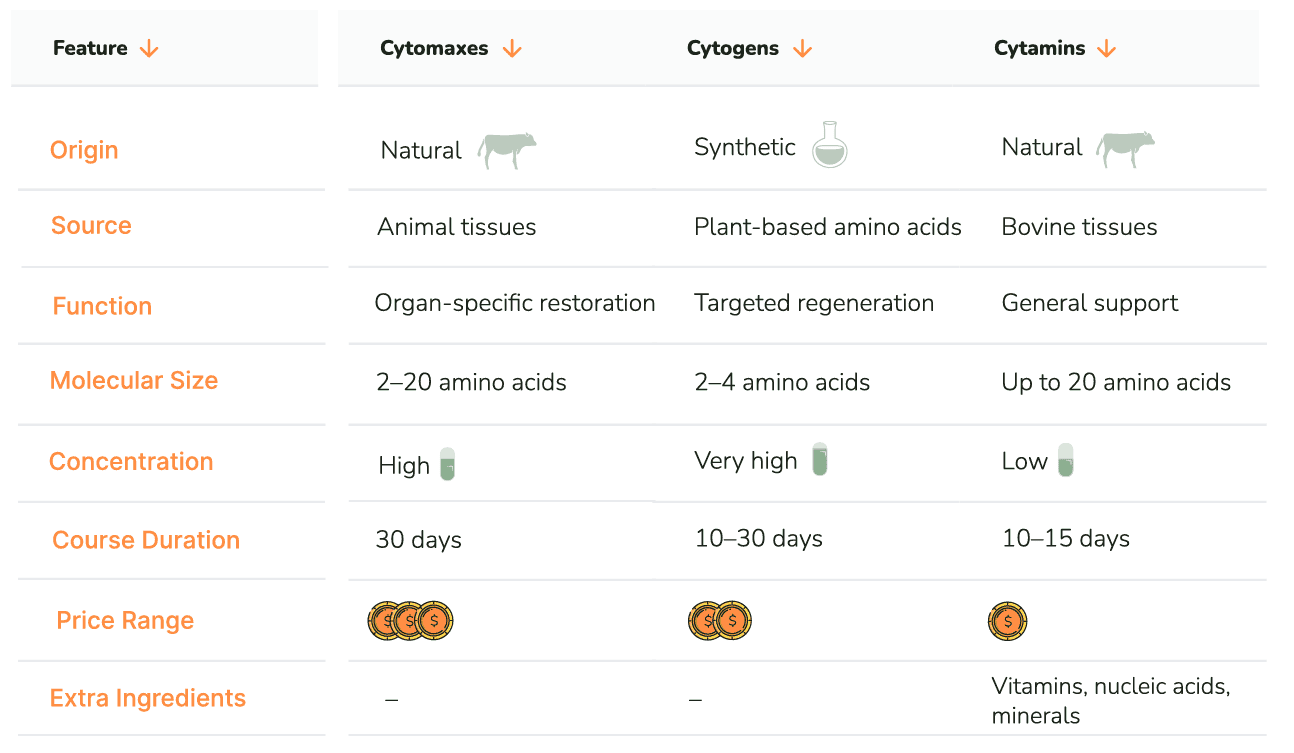
We have a full PDF guide on these different types of bioregulators available in the Resources section.
Current Evidence and Ongoing Research on Peptide Bioregulators
Preclinical studies show that several short peptides derived from thymus and pineal gland extracts (e.g., Thymogen, Vilon, Epitalon, and Thymalin) can modulate the expression of dozens of genes involved in cell proliferation, apoptosis, immune regulation, and oncogenesis in cell cultures and animal models. These peptides have been reported to influence chromatin structure, activate
telomerase
Telomerase
— An enzyme that helps maintain the protective ends of chromosomes, called telomeres, during cell division.
Go to Glossary
, reduce
oxidative stress
Oxidative Stress
— An imbalance of free radicals and antioxidants in the body that leads to cell damage.
Go to Glossary
markers, and improve survival in experimental models of accelerated or age‑related pathology.
longevity
Longevity
— The practice of using various techniques, technologies, and lifestyle changes to extend lifespan and improve overall health and wellness.
Go to Glossary
/" target="_blank" rel="noreferrer noopener">
Clinical data consist mainly of small, often single‑center studies in older adults or patients with chronic cardiovascular, immune, or neurodegenerative diseases receiving courses of organ‑specific peptide preparations. Some reports suggest improved functional scores, reduced incidence of certain age‑related conditions, and modest increases in survival over several years of follow‑up, but these studies frequently lack contemporary design features such as randomization, blinding, and rigorous endpoint adjudication.
Because of these limitations, peptide bioregulators should currently be considered experimental geroprotective and organ‑support therapies with promising but not yet conclusively proven clinical benefits. Future research needs include large randomized controlled trials, standardized outcome measures, and independent replication of key findings outside the original research groups.
Summary
Peptide bioregulators represent a diverse class of molecules with potential organ-specific, geroprotective, and systemic effects. Preclinical and small clinical studies suggest benefits such as enhanced protein synthesis, immune modulation, and improved tissue resilience, but large, high-quality clinical trials are still needed to confirm these effects. Overall, peptide bioregulators are gaining popularity, are generally considered safe when used as directed, and continue to be an active area of research in biogerontology and therapeutic development. Read more about peptide bioregulators in the article Peptide Bioregulators Under The Microscope: All You Need To Know.
References
-
Avolio F. et al. (2022).
“Peptides Regulating Proliferative Activity and Inflammatory Pathways in the Monocyte/Macrophage THP-1 Cell Line”.
Int J Mol Sci. 23(7):3607.
Link -
Khavinson V. (2020).
“Peptide medicines: past, present, future”.
Clinical Medicine (Russian Journal). 2020;98(3):165-177.
Link -
Khavinson V., Popovich I. (2017).
“Short Peptides Regulate Gene Expression, Protein Synthesis and Enhance Life Span”.
RSC Drug Discovery Series No. 57.
Link -
Khavinson V. et al (2012).
“Peptide Bioregulators: A New Class of Geroprotectors. Message 1: Results of Experimental Studies”.
Advances in Gerontology, 2013, Vol. 3, No. 3, pp. 225–235.
Link -
Khavinson et al. (2009).
“Peptide regulation of aging: 35-year research experience”.
Bull Exp Biol Med. 148(1):94-8.
Link
See comments
0
0
Up next All articles
Useful Links
References